Have questions about the project?
Have questions about this project or want to discuss a similar idea? I’d be happy to connect and explore how we can work together.


Category: Automotive Software Engineering
Technology: AUTOSAR Classic, Embedded C, Vector SystemDesk, Vector VEOS
Project Type: Academic Engineering Project
Modern vehicles rely on embedded software systems to improve driving comfort, vehicle control, and safety.
Cruise Control and Emergency Braking are two important automotive functionalities that demonstrate how electronic control units (ECUs) process driver inputs, monitor vehicle conditions, and execute control decisions.
As part of my Automotive Software Engineering studies, I worked on an academic project to explore the implementation of Cruise Control and Emergency Braking concepts using AUTOSAR Classic architecture and Embedded C programming.
The project focuses on component-based software development, communication between Software Components (SWCs), vehicle speed monitoring, and emergency braking logic.
The main objectives were:
Understand AUTOSAR Classic software architecture.
Design modular Automotive Software Components.
Implement Cruise Control functionality using C.
Monitor vehicle speed and target speed.
Handle accelerator and brake pedal inputs.
Explore emergency braking distance calculation.
Understand AUTOSAR Runtime Environment (RTE) communication.
Explore virtual ECU simulation using Vector VEOS.
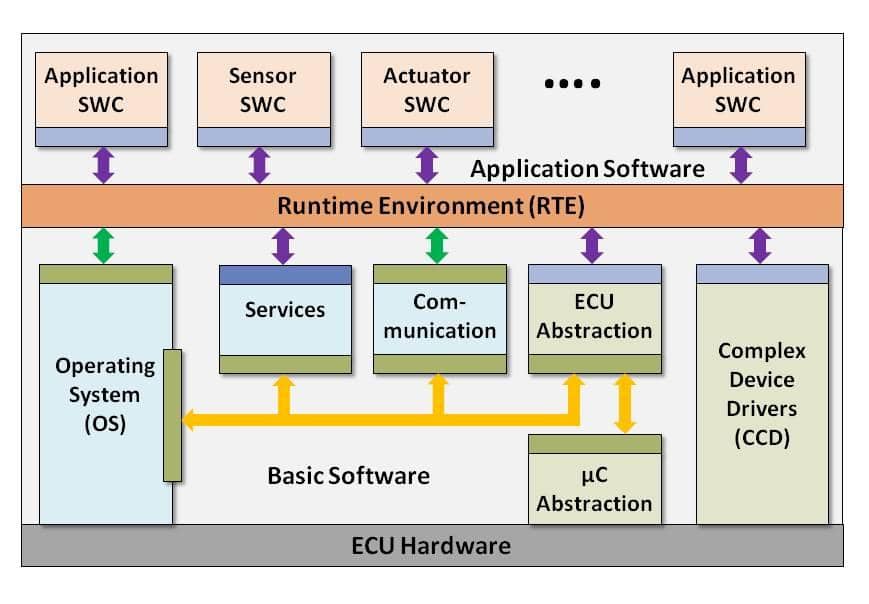
The project follows a component-based architecture in which individual software components perform specific tasks.
The main components include:
CruiseControlSWC
Responsible for cruise control functionality and speed regulation.
TargetSpeedControl
Handles target speed adjustment and management.
These components communicate through AUTOSAR RTE interfaces.
Emergency Brake SWC
Implements braking-distance calculation and emergency braking logic.
EngineControl
Contains simplified engine control and injection calculation logic.
AccidentRecorder
Monitors acceleration thresholds and supports accident recording requests.
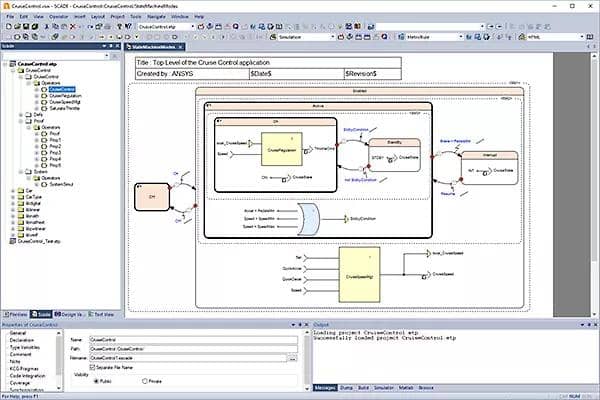
The Cruise Control component manages the target vehicle speed and monitors the current vehicle speed.
It explores how embedded software can maintain a requested speed through control logic.
Target Speed Management
The Target Speed component handles the driver’s requested speed and provides the target value for the cruise control functionality.
Emergency Braking
The emergency braking component explores braking-distance calculation and emergency braking decisions based on vehicle-related inputs.
Accident Detection
The Accident Recorder monitors acceleration thresholds and generates an accident recording request when the defined condition is met.
Engine Control
The engine control component demonstrates simplified engine control and injection calculation logic.
| Technology | Purpose |
|---|---|
| Embedded C | Software Component implementation |
| AUTOSAR Classic | Automotive software architecture |
| Vector SystemDesk | System and Software Component design |
| Vector VEOS | Virtual ECU simulation environment |
| AUTOSAR RTE | Communication between Software Components |
The project follows these development steps:
Define the automotive software requirements.
Design Software Components and interfaces in Vector SystemDesk.
Configure component ports and internal behaviours.
Generate or configure the AUTOSAR Runtime Environment.
Implement software component logic using C.
Prepare the virtual simulation environment using Vector VEOS.
Evaluate component behaviour using simulation inputs and outputs.
Through this project, I explored:
AUTOSAR Classic architecture.
Embedded C programming.
Software Component development.
AUTOSAR RTE communication concepts.
Automotive control logic.
Cruise Control functionality.
Emergency Braking concepts.
Virtual ECU simulation.
Component-based automotive software development.
This project strengthened my understanding of modular automotive software development and the role of AUTOSAR in modern vehicle electronics.
The source code and project documentation are available on GitHub.
GitHub Repository:
https://github.com/obydur/AUTOSAR-Classic-Cruise-Control-Emergency-Braking
The repository includes C source files, project images, implementation documentation, and original project task materials.
This academic project provided practical exposure to AUTOSAR Classic architecture and automotive embedded software development.
By exploring Cruise Control, Emergency Braking, and communication between Software Components, I gained a better understanding of how modular automotive software systems are structured and developed.
I am continuing to strengthen my skills in Embedded C, AUTOSAR, ECU development, and automotive software engineering.
Author: Obydur Rahman
M.Sc. Automotive Software Engineering
Technische Universität Chemnitz, Germany
Disclaimer: This is an academic software prototype developed for educational purposes. It is not certified, validated, or intended for use in real vehicles or safety-critical applications.
Have questions about this project or want to discuss a similar idea? I’d be happy to connect and explore how we can work together.